
What is the Revenue Dashboard?
The Revenue Dashboard shows how much money your site is making and spending. It puts two important things on one page:
- Revenue: the money your site takes in (for example, from food, drinks and rooms)
- Payroll: the money you pay your team members
The figures update on their own, so you always see the newest information.
Why use the Revenue Dashboard?
You can use the Revenue Dashboard to:
- Check your sales and team costs for a day, a week or a month
- Compare what you expected (forecast) with what really happened (actuals)
- Compare your figures with your budget or with past results
- Find problems early, for example when team costs are high but sales are low
- Check your forecast against your budget before you freeze the forecast each week
How to open the Revenue Dashboard
- Open the mega menu.
- Select Revenue Dashboard.
The dashboard opens on the current week.
How to choose a time period
- Look at the headers along the top of the dashboard.
- Select Day, Week, MTD or Month.
To see a different date:
- Select the calendar.
- Choose the date or dates you want to see.
How to choose what to compare
You can compare your figures in three ways:
- Forecast: compare what you expected with what really happened.
- Budget: compare your figures with your budget targets. To learn how budgets are added, see Budget Revenue.
- Historical: compare your figures with the same period in the past.
Select the option you need at the top of the dashboard.
How to read the tiles
Your figures are shown in tiles (boxes). Each division has its own section. A division can have several departments. Each department can have several revenue streams.
Forecast tile
This shows the revenue and payroll you expected.
- Hover over the Revenue column to see which revenue streams make up the total.
- Hover over the Payroll column to see how the team cost was worked out.
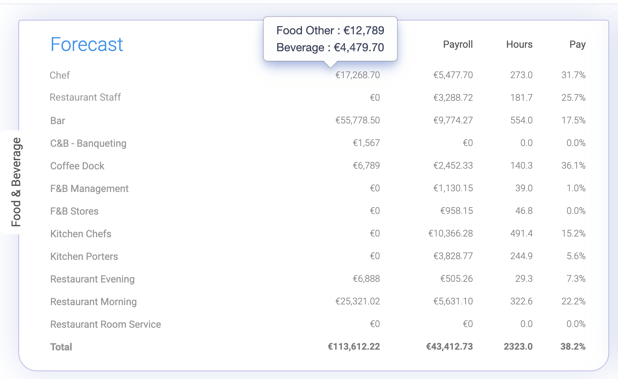
To learn how to add these figures, see How to enter Forecast in Revenue.
Actual tile
This shows the revenue and payroll that really happened. Hover over each column to see more detail, the same as the Forecast tile.
To learn how to add these figures, see How to enter Actuals in Revenue.
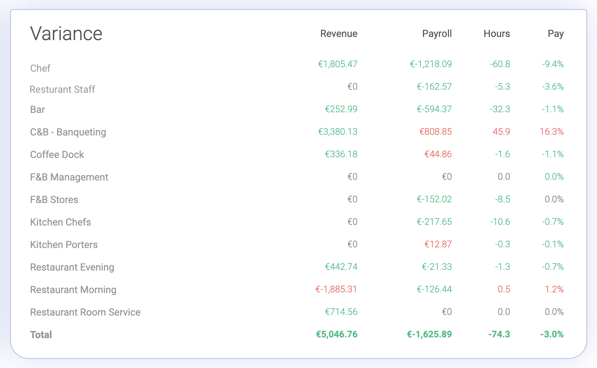
Variance tile
This shows the difference between the Forecast tile and the Actual tile. The colours help you see quickly how the business is doing:
- Green: revenue is higher and payroll is lower than expected. This is a good result.
- Red: revenue is lower and payroll is higher than expected. You may need to take action.
Summary tiles
Scroll to the bottom of the page to see the Summary tiles. These show the totals for the whole site. They can also include other costs, such as employee meals and training costs.

The Freeze Forecast button
When you compare with Budget, you will see the Freeze Forecast button. It is here for a reason: before you freeze your forecast, you should check it against your budget.
Each week, your team should follow these steps in this order:
- Enter your forecast revenue.
- Plan your team members’ shifts (the roster) based on that forecast.
- Check your forecast against your budget, then freeze the forecast.
Freezing the forecast is always the last step. For the full steps, see the article Freezing the Forecast.
Need a new department?
Departments are set up when Alkimii is first installed. If you need a new department, please contact our Customer Success team at hello@alkimii.com.
Key words on this page
| Forecast: the money you expect to take in and spend on payroll. |
| Actuals: the money you really took in and really spent on payroll. |
| Budget: the targets your business has set for each period. |
| Historical: figures from the same period in the past. |
| Variance: the difference between two sets of figures. |
| MTD (Month to Date): from the first day of the month up to today. |
| Division: a group of departments, for example Food and Beverage. |
| Department: one area of your business, for example Restaurant or Bar. |
| Revenue stream: one way your business makes money, for example Breakfast or Wine. |